Accueil
» Wiki
»
How to Create a Monthly Spending Tracker on Google Sheets
How to Create a Monthly Spending Tracker on Google Sheets
Finances can be a daunting task, but thanks to Google Sheets , keeping track of your spending doesn't have to be a hassle. You don't have to invest in another software either.
With a simple expense tracker built with Google Sheets, you can track your expenses and make sure you don't overspend.
Tracking your spending can seem like a daunting task if you've never done it before, but keeping things simple will help you get started. Start by creating two sheets in your spreadsheet—one to record your expenses and another to summarize and visualize them.
The first worksheet must have at least the following 5 columns:
Location : The store you visited
Category : The type of item you purchased
Amount : The total amount you paid in that transaction
Date : the date you made the purchase
Month : The month the purchase date is in - this column will be used to generate the summary.
You may want to go deeper and track each individual item, but doing so will add time to the process and you may lose interest. If you tend to forget what you bought at a store, add a column for quick, general notes or just to keep track of your receipts.
Create color-coded drop-down menus for spending categories in Google Sheets
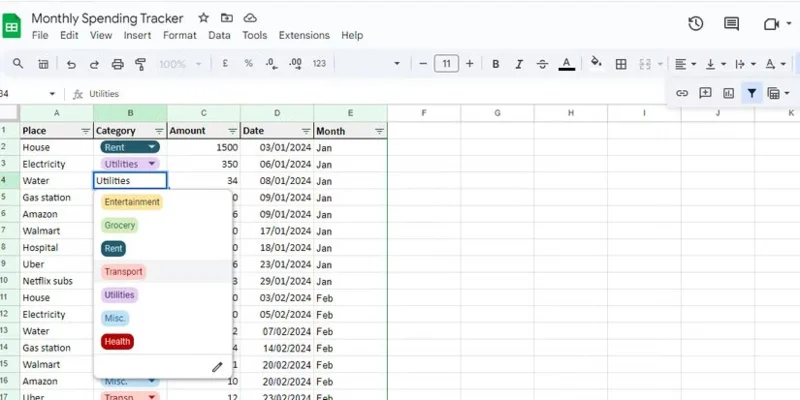
You can use the drop-down list in Google Sheets to add categories to your transactions. Doing this will allow you to quickly select an option with just a few clicks, instead of having to type it in manually each time. It also helps keep your input consistent, so you can easily find and sort it later.
You can follow these steps:
Highlight the Category column . Hold CMD or CTRL , uncheck the header cell.
Right-click with your mouse or trackpad. Or, go to Insert in the top menu. Click Dropdown . This will open the sidebar.
Enter the categories you want to include in the text field. Click Add another item to create additional options, or you can press Enter or Return on your keyboard.
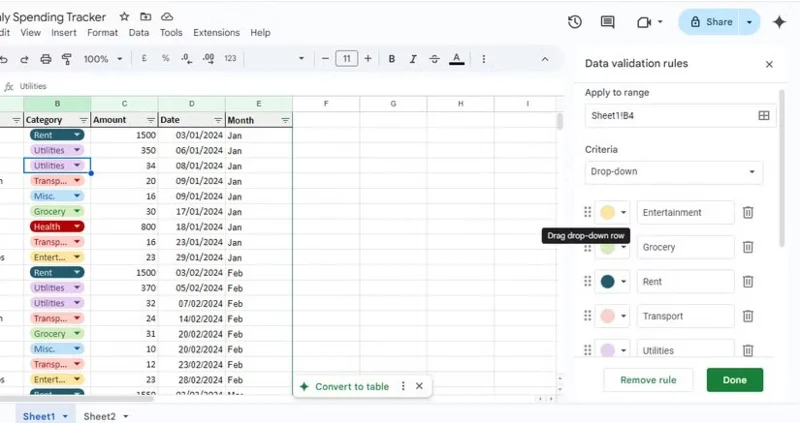
Color code your categories using the drop-down menu to the left of the text field and press Done .
Then, if you want to go back and edit or add to the drop-down list, you can find the menu again by right-clicking on one of the cells and selecting Dropdown again . You can also access it through the Data menu at the top of the screen, where you select Data validation . Now, you will find a list of rules, and you can select the rule you want to use.
Tracking tool format
If you want to keep the date and currency formatting consistent in every cell in your Google Sheets, here's how to do it:
Date format
If you're using a date column and want to keep things consistent, you can add specific formatting to your cells. To do this:
Select the entire column by the letter at the top.
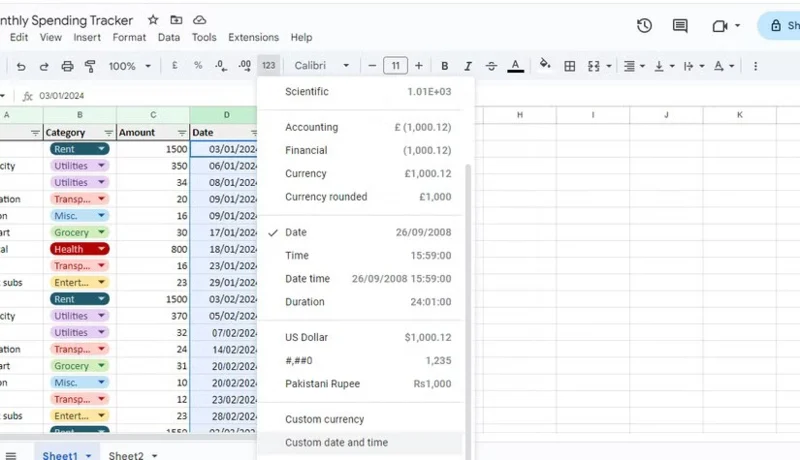
In your toolbar, click More formats - its symbol is 123 .
Select Date - next to it is an example of how the date will display.
Date Format in Google Sheets
Alternatively, you can do this by going to the Format menu at the top and under Number , select Date or Custom date and time .
Month format
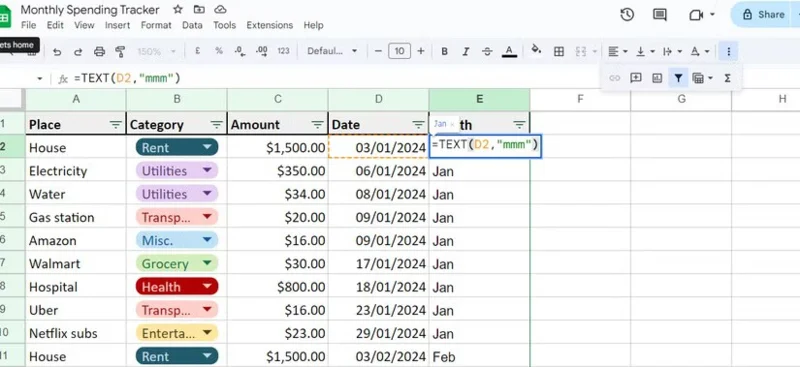
Instead of entering the month every time you enter any transaction, it is better to use the TEXT function to automatically extract and display the month name from the purchase date. To do this, go to the first row in the Month column and enter the following:
=TEXT(tham chiếu của ô chứa ngày tương ứng, "mmm")
Using the TEXT function in Google Sheets
So if the date is in cell D2, the formula would look like this:
=TEXT(D2, "mmm")
This will return the first three letters of the month in the Month column. Once applied to the first cell, you can highlight the first cell and drag down to apply to other cells in the column.
Currency format
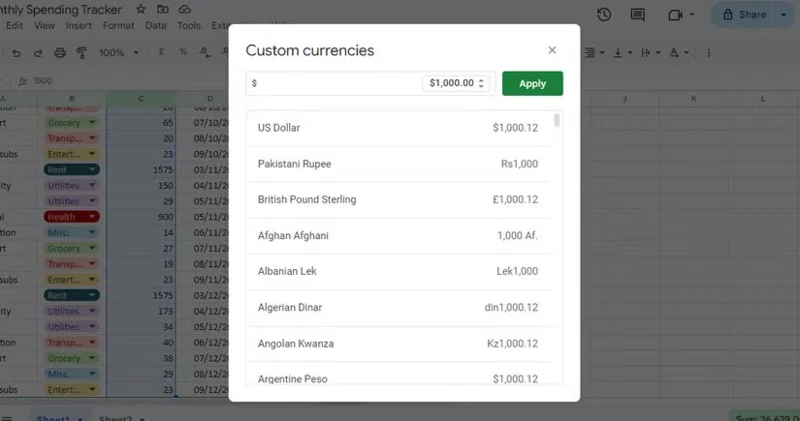
To add currency formatting to an amount column, select the entire column > More formats and click the dollar sign ($) on the toolbar. You can also find the option in the Format menu under Number . Here, you can choose Currency , Currency rounded , and Custom currency .
Custom Currency Format for Google Sheets
Custom currencies allow you to toggle how decimals and symbols are displayed, specify the type of dollars you're using, or choose a different currency entirely.
Create cost summary using functions
Once you've created a worksheet to record your expenses, switch to a new worksheet to summarize your expenses.
From cells B1 to M1, enter the first three letters of each month's name. Column N will be used for the total categories. Similarly, from the second cell of column A, start entering the expense categories.
Make sure to include the same categories as in the drop-down list of the first sheet. Once all the categories are entered, the next cell in the column will be used for the Monthly total.
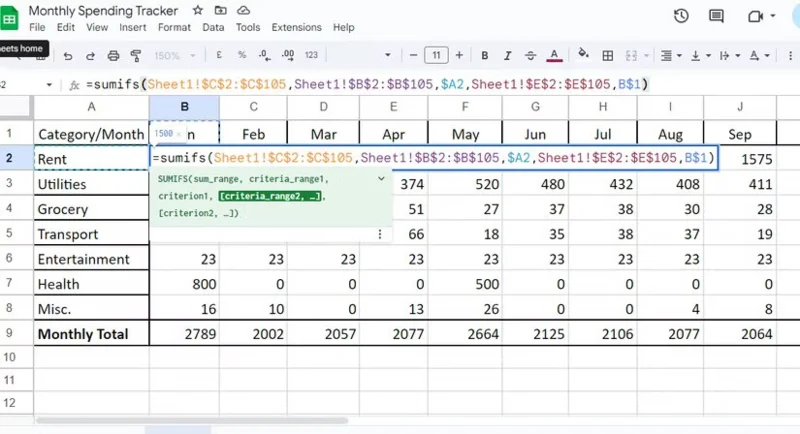
Now that you have the basic structure, it's time to use the SUMIFS function to fill in the summary. This function will sum the selected range if multiple conditions are met.
In cell B2, enter the formula
=SUMIFS(Phạm vi cột Amount của trang tính đầu tiên, Phạm vi cột Category của trang tính đầu tiên, A2, Phạm vi cột Month của trang tính đầu tiên, B1).
Next, make all cell references absolute by selecting the cell reference and pressing F4 . Next, remove the $ sign that appears before 2 (in A2) and B (in B1).
SUMIFS function in Google Sheets
In the example, the function would look like this:
After entering the formula, select cell B2 and drag down to the last cell before the Monthly total row. Then, select the entire range from cell B2 to the last cell before the Monthly total and drag right until column M .
Next, in column N2 , enter the formula =SUM(B2:M2) and drag down. Similarly, use the SUM function in Monthly total to add up the expenses of all categories incurred in a particular month.
Cost Summary in Google Sheets
Now, whenever you add expenses to the first sheet, Google Sheets will continue to add them to the relevant month and category in the summary. Plus, you can see how much you spend each month and how much you spent on a particular category for the year.
Visualize costs with pie charts and sparklines
To better understand your spending habits, you can visualize your expenses using Google Sheets.
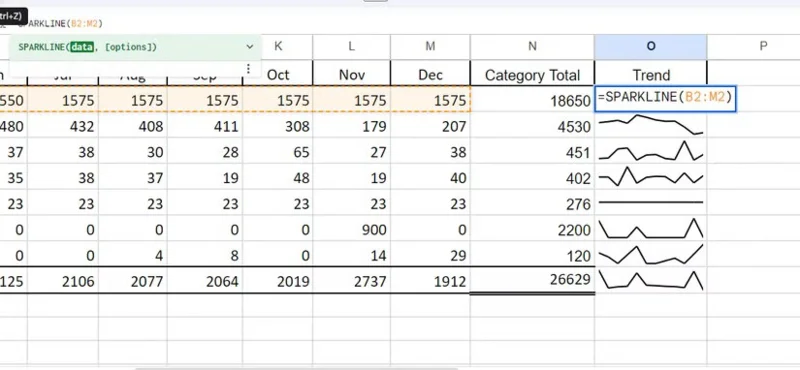
First, add a sparkline to see how your spending on a specific category changes each month. In cell O2, enter the formula below:
=SPARKLINE(B2:M2)
Then scroll down to the last category. You can also customize the appearance of the sparkline.
Create sparklines in Google Sheets
Next, add a pie chart to see a detailed breakdown by category of total costs. To do this, select Insert > Chart . This will add a new chart and open the chart editor in the sidebar.
From the chart type drop-down list, select Pie chart or 3D Pie chart . In Data range , add the range N1:N8 (or whatever your last cell is). Then, click Add label and the 4 squares icon to select the data range for the label.
Here, enter the range A1:A8 . Sheets will now display a pie chart showing your cost breakdown.
Chart Editor in Google Sheets
Use filters to view spending categories
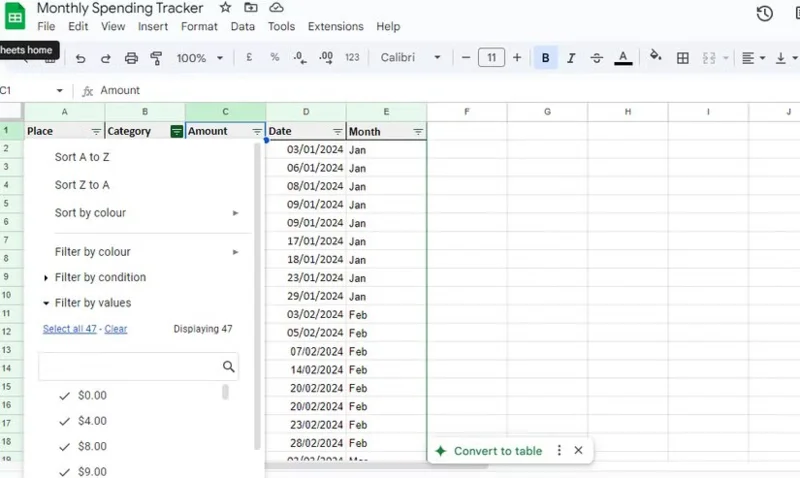
If you want to sort or hide transactions, you can add filters to your Google Sheets. To do this, select the column you want to sort and click the Create a filter icon in the toolbar. Three lines will appear next to the column header.
Click on the three lines and you will see a list of options. In the category columns, you can use Filter by value to quickly display a category, use the checkbox below the title to select and deselect them by name.
You can also use Sort A to Z in the amount column to view your transactions from least expensive to most expensive, or Sort Z to A to sort in reverse.
Use filters to sort expenses in Google Sheets
With this simple expense tracker, you can keep a good track of your spending. Plus, unlike templates you download from the internet, if something goes wrong with your spreadsheet, you'll know exactly how to fix it.
You can use the Google Sheets app on your phone to easily enter transactions on the go. That way, you don't have to deal with everything at the end of the month. Better yet, you can create a spreadsheet to plan your spending in advance.