Comment faire un sondage sur WhatsApp

Découvrez Comment faire un sondage sur WhatsApp étape par étape. Guide complet pour Android, iOS et bureau avec limites, confidentialité et astuces pro.
Do you often feel annoyed when every time you turn on mobile data (4G, 5G) on your Android Smartphone, applications compete to notify Updates while the budget for mobile data network is limited?
Fortunately, Android makes it easy to keep track of your data usage. You can even set up alerts to send you when background data usage by apps exceeds a certain limit. You can also take the more drastic approach of blocking specific apps from using mobile data in the background.
This article will guide you how to block apps from accessing the Internet, using mobile data in the background to save bandwidth and mobile data usage, using Android's built-in settings options, as well as specialized third-party apps.
How to prevent Android apps from accessing the Internet
Not all Android phones have these options, and it seems that recent versions of Android have removed them altogether.
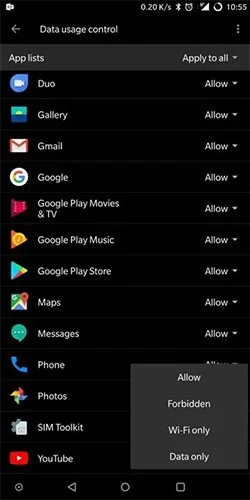
For example, if you're a OnePlus user, you can go to Settings > Data Usage > your SIM card .
Tap the menu icon, then tap Data usage control .

From here you'll see the full list of apps and can tap the drop-down menu to the right of each one to control whether you want them to connect online over WiFi only, data only, or not at all.
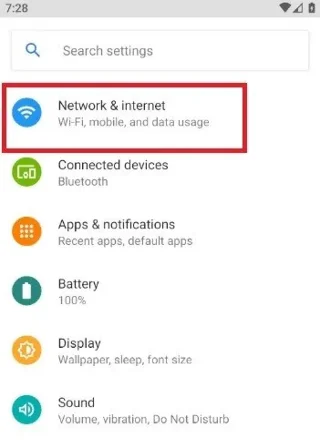
On certain Android phones (Android 9.0 Pie and above), you can do the same by going to Settings > Network & Internet > Mobile network > Data usage > Network access , then control which apps have access to data and WiFi using the checkboxes.
With Android's built-in features, users won't have many choices, so if you want more control, you can use a third-party app.
Step 1 : First download and install this application on your Android mobile phone.
Step 2 : Once installed, run the application and you will see the Firewall Rules option , tap on it.
Step 3: Now you will see a list of all the apps installed on your device and before each app there will be two signs, one is Wifi and the other is mobile network. You just need to tap on them to turn off access.

Step 4: Now go back and then turn on Firewall, a window will appear and just press OK .
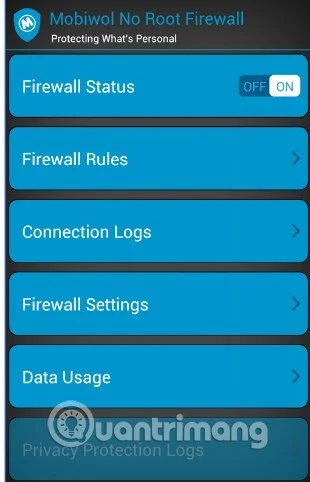
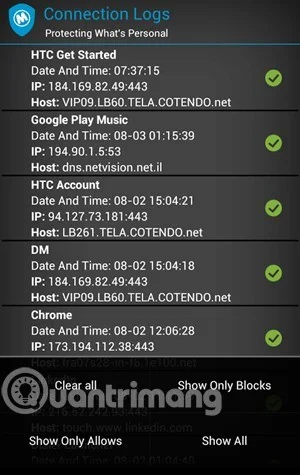
That's it, now these apps can't access the Internet. You can check the app connection logs by opening the app and viewing the Connection Logs generated in the respective app.
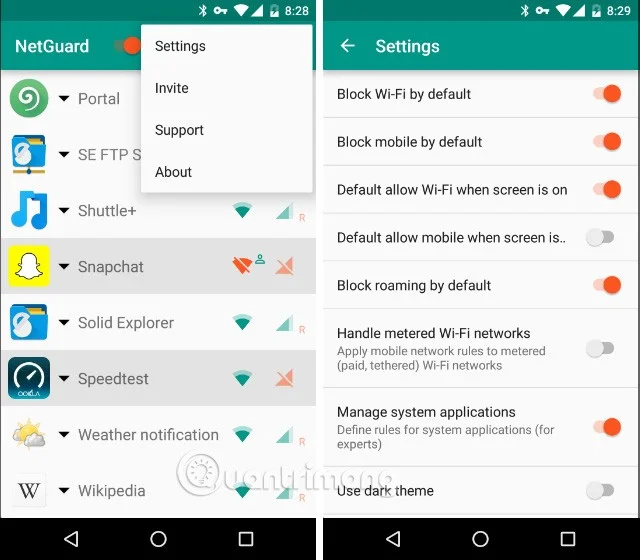
This is another best and popular Android app that can block apps from accessing the internet. NetGuard offers simple and advanced ways to block network access without rooting your device. You can block or allow individual apps and addresses to access your Wifi or mobile connection.
Step 1. First of all, download and install NetGuard on your Android smartphone.
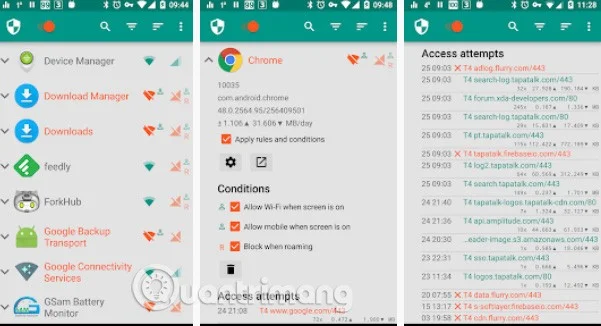
Step 2. After installation, open the application and you will see its main interface. NetGuard will list all the applications installed on your Android phone.
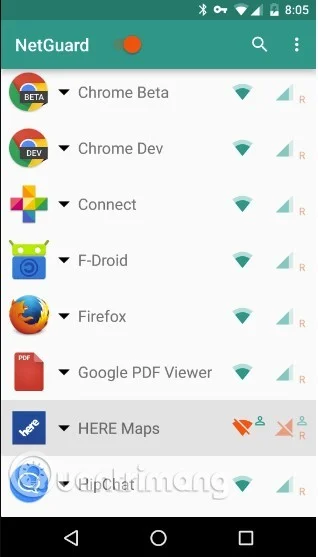
Step 3. Now select the apps you don't want to access the Internet by unchecking Allow WiFi or Allow Mobile .
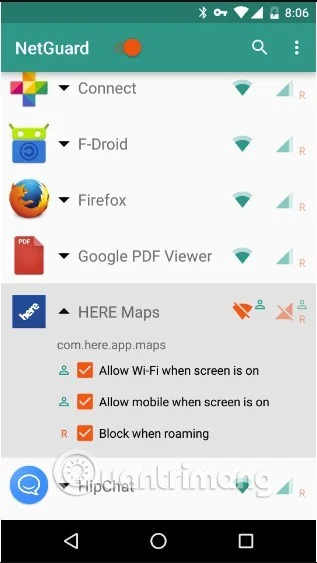
Step 4. If you want to block all apps at once, open Settings and enable the Block WiFi by default and Block Mobile By Default options .
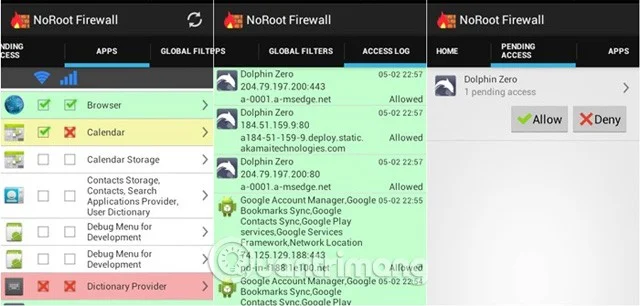
NoRoot Firewall does not require rooting your device. It protects your personal information from being sent over the Internet. NoRoot firewall notifies the user when an application attempts to access the Internet. To do this, simply tap the Allow or Deny button . NoRoot Firewall allows users to create filtering rules based on IP address , hostname or domain name. You can allow or block a specific application's connection.
The software requires that your Android phone is rooted. DroidWall will manage which apps are allowed/disallowed to connect to the Internet via Wi-Fi or 3G - your choice of course.
DroidWall operates in two modes: Whitelist and Blacklist. Blacklist mode includes applications that are blocked from accessing the Internet, while Whitelist mode includes applications that are allowed to access the Internet.
You can change these two modes by clicking on the red frame as shown:
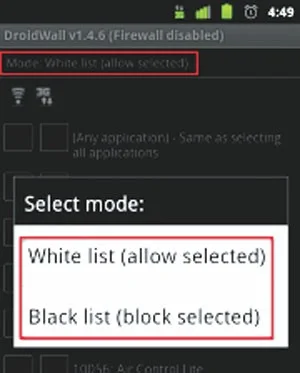
By default, DroidWall will initially be in Whitelist mode, users who want to switch to Blacklist mode must change it themselves. It should also be noted that the default “firewall” is usually disabled at first, so you must activate it yourself.
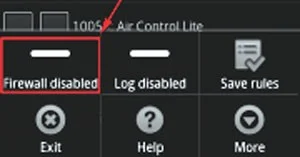
Once you’ve selected the mode you want and enabled the firewall – it’s as simple as checking the boxes next to the app names to allow/disallow network access (depending on which mode you’ve selected). As you can see in the images above, you can choose to block access from Wi-Fi or mobile data, or both. Note that although the icon is 3G, it will still work with 2G and 4G networks. And once you’ve ticked the apps you want, click Save rules.
Whenever you want to edit the internet access permissions of your apps, just launch DroidWall, change whatever you want to change, and click Save rules.
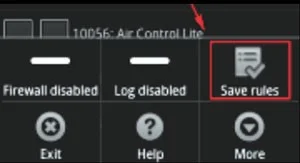
Another feature in DroidWall is to set a password to protect it so that others cannot change the settings you have chosen. To enable this feature, press the Menu button on your phone, then press More and select Set password. Enter the password you want and later when you start DroidWall, you will have to enter the password to be able to use the application. To remove the password, go to Set password and press OK.
If your goal is to simply reduce the internet usage of apps rather than stop them altogether, there are a few common methods you can try. With Android 7.0 and above, you can use the data saver feature. To access it, go to Settings > Network & Internet and select your WiFi network. On some phones, it may be an icon.
The data saver menu has a toggle switch that is set to off. Once you turn it on, you will see a list of apps that can control Internet access.
By turning on data saver, you can stop video autoplay and automatic downloads, and limit unnecessary images.
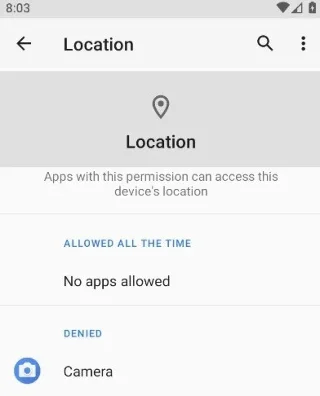
For added restrictions, you can also turn off location access for all apps when not in use and reduce background data usage.
To regain Internet access for apps again, simply re-enable the WiFi and mobile data icons.
Above are ways to block applications from accessing the Internet on Android, with these methods, you can save Internet bandwidth to get maximum speed and mobile data capacity.
See also:
Découvrez Comment faire un sondage sur WhatsApp étape par étape. Guide complet pour Android, iOS et bureau avec limites, confidentialité et astuces pro.
Votre précieux Samsung Galaxy n'a pas besoin de ressembler exactement à tous les autres téléphones du marché. Avec quelques ajustements, vous pouvez le rendre plus personnel, élégant et unique.
Après s'être lassés d'iOS, ils sont finalement passés aux téléphones Samsung et ne regrettent pas cette décision.
Changer le DNS sur iPhone ou changer le DNS sur Android vous aidera à maintenir une connexion stable, à augmenter la vitesse de connexion réseau et à accéder aux sites Web bloqués.
L'interface Web du compte Apple dans votre navigateur vous permet de consulter vos informations personnelles, de modifier vos paramètres, de gérer vos abonnements, et bien plus encore. Cependant, il arrive parfois que vous ne puissiez pas vous connecter pour diverses raisons.
Lorsque Find My devient inexact ou peu fiable, appliquez quelques modifications pour le rendre plus précis lorsque vous en avez le plus besoin.
Beaucoup de gens ne s’attendaient pas à ce que l’appareil photo le plus faible de leur téléphone devienne une arme secrète pour la photographie créative.
Apple a lancé l'Adaptive Power, qui fonctionne en complément du mode Faible consommation. Ces deux fonctions prolongent l'autonomie de la batterie de l'iPhone, mais fonctionnent de manière très différente.
La communication en champ proche est une technologie sans fil qui permet aux appareils d'échanger des données lorsqu'ils sont à proximité les uns des autres, généralement à quelques centimètres près.
Grâce aux applications à clic automatique, vous n'aurez plus grand-chose à faire lorsque vous jouerez à des jeux, utiliserez des applications ou effectuerez des tâches sur l'appareil.