Accueil
» Wiki
»
Halloween from space: Galactic duo emerges as creepy eyes staring from space
Halloween from space: Galactic duo emerges as creepy eyes staring from space
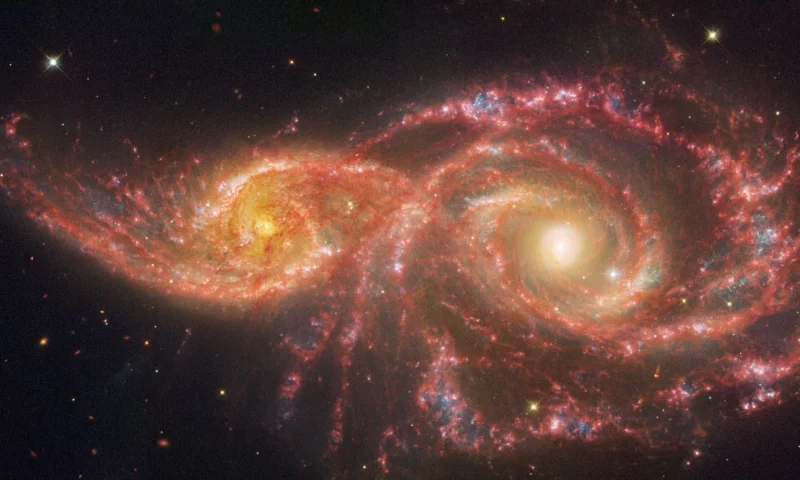
These sinister yet hauntingly beautiful eyes appear in a new Halloween-themed image, using data from both the Hubble Space Telescope and the world’s most expensive space telescope, the James Webb Space Telescope. They are actually the galaxy pair IC 2163 (left) and NGC 2207 (right) interacting and moving closer to form a galaxy cluster with many interesting features.
In reality, these two galaxies won’t collide directly, as one passes in front of the other. However, the interaction is close enough for the light from the two galaxies to interfere with each other, creating some rare effects. If you look closely at the galaxy on the left, you can see how its spiral arms have been stretched out into elongated shapes, likely due to its close passage into the gravitational pull of the other nearby galaxy. The bright red lines around the “eyes” are created by shockwaves, as material from each galaxy collides with the other.
While this interaction may sound violent, it also helps spur star formation. That’s because the force of gravity pulling on the dust and gas in each galaxy can create compressed regions where the higher density makes it more likely for clumps to form, eventually turning into stars. This process creates bright, young stars that shine throughout both galaxies.
“Both galaxies have high rates of star formation, like countless individual hearts pulsing throughout their arms, ” explains James Webb, a scientist at the University of California, Berkeley. “IC 2163 and NGC 2207 produce about two dozen new Sun-sized stars each year. By comparison, our own Milky Way galaxy produces only about two or three new Sun-like stars each year. In addition, the two galaxies have also hosted seven known supernova events in recent decades, a high number compared to an average of one every 50 years in the Milky Way. Each supernova would have cleared space in the galaxy’s arms, rearranging gas and dust, then cooling and allowing more new stars to form .”
The image combines infrared light from the NASA/ESA/CSA James Webb Space Telescope and visible and ultraviolet light from the NASA/ESA Hubble Space Telescope. The pair passed each other millions of years ago. The smaller spiral galaxy on the left, catalogued as IC 2163, passed behind NGC 2207, the larger spiral galaxy on the right. Both have increased star formation rates. Combined, they are estimated to produce the equivalent of two dozen new stars the size of the Sun each year.
You can see the star-forming regions by looking at the glowing blue regions (from Hubble data) and the pink and white regions (from James Webb data). The two telescopes produce images that look different because they operate at different wavelengths. Hubble looks at the visible light spectrum, similar to what the human eye sees, while Webb looks in the infrared, seeing things we can't and highlighting the busy "starburst" regions where lots of new stars are forming.