The full moon is a common astronomical phenomenon that only appears once a month. What is the special meaning of the full moon and when does it appear? Let's find out with Quantrimang.com!
A full moon occurs when our planet, Earth, is positioned exactly between the Sun and the Moon. This alignment ensures that the entire Moon facing us will sparkle in the sunlight. Because of the Moon's orbit around the Earth, the angle at which sunlight hits the Moon's surface and is reflected back to Earth is different. This creates the different phases of the Moon.
Every month there will be a full moon - Full Moon
In reality, one side of the moon faces the planet, while the other side is always in shadow. And in fact, most of the time a " full moon " isn't completely full. Only when the moon, Earth , and Sun are all aligned is the moon truly 100% full, and that alignment results in a lunar eclipse . Sometimes—very rarely—there are two full moons in a month ( or four in a season, depending on how you look ). That rare event occurred on May 21 of this year.
The next Full Moon will be the Harvest Moon , which will occur tomorrow - Friday, September 16. Meanwhile, the Full Moon will be visible at 3:05 p.m. local time ( 1905 GMT ), which will be the fullest moon in conventional astrology a day before and a day after the official date. The Harvest Moon is known as the " Chrysanthemum " Moon in Chinese culture. The Harvest Moon in September coincides with a " penumbral lunar eclipse " - which will be visible in Europe, Africa, Asia, Australia and the Western Pacific regions.
Full Moon Calendar 2024
Different cultures have different names for full moons. These names are often derived from the phenomena that occur during the month. The Farmer 's Almanac lists some of these names and explains some of the variations , but in general, these names were used by Algonquin tribes from western New England to Lake Superior . European settlers retained their own customs and created some new names.
Full moons are truly beautiful and they have some really cool names associated with interesting natural phenomena. Here is a complete list of this year's full moons and their traditional names.
Here's the full moon calendar for 2024, according to NASA:
- January 25: The Wolf Moon . The Wolf Moon occurs at a time when one can hear the howling of hungry wolves in midwinter.
- February 24: The Snow Moon . The Snow Moon occurs in the winter of February, when the snows are heaviest. This is also when hunting becomes difficult, so it is also known as the Hunger Moon .
- March 25: The Worm Moon . The Worm Moon occurs when temperatures begin to rise and warm, the ground becomes spongy, and earthworms begin to reappear. Alternate names: Sap Moon or Crow Moon .
- April 23: The Pink Moon . The Pink Moon is when wildflowers begin to bloom pink. Other names: Grass Moon , Egg Moon , or Fish Moon .
- May 23: The Flower Moon . Flower Moon as countless flowers begin to bloom this month. Alternate names: The Corn Planting Moon or Milk Moon .
- June 21: The Strawberry Moon . The Strawberry Moon is a time when the Algonquin Native American tribe flocked to pick ripe strawberries. Alternative names: The Honey Moon , Rose Moon , or Hot Moon .
- July 21: The Buck Moon or Thunder Moon . The Buck Moon is when deer begin to grow new antlers. Alternate names: Thunder Moon ( because of the frequent thunderstorms ), or Hay Moon .
- August 19: The Sturgeon Moon . The Sturgeon Moon is named for the time when Native American tribes could easily catch fish. Alternative names: Green Corn Moon , Red Moon , Grain Moon .
- September 17: Harvest Moon . The Full Moon is closest to the Autumn Equinox and can occur in September or October, or the Barley Moon .
- October 17: The Hunter's Moon . The Hunter's Moon was when Native American tribes began hunting and storing food for the winter.
- November 15: The Beaver Moon . Named after the time when Native Americans set beaver traps before the water began to freeze over, it is also the time when beavers begin preparing for winter.
- December 15: The Cold Moon . December 's moon is named for the middle of winter, when the cold really hits and the nights get longer and darker.
There is also the name Full Moon . Native Americans often called them by different names. In the book " This Day in North American Indian History " published by Da Capo in 2002, author Phil Konstantin listed more than 50 Native American names and names for the Full Moon phenomenon. Phil Konstantin also listed it on his personal website AmericanIndian.net .
Amateur astronomer Keith Cooley has a brief list of moon names in different cultures, including Chinese and Celtic, on his website. For example:
Chinese Moon Names
- January: Holiday Moon
- February: Budding Moon
- March: Sleepy Moon
- April: Peony Moon
- May: Dragon Moon
- June: Lotus Moon
- July: Hungry Ghost Moon
- August: Harvest Moon
- September: Chrysanthemum Moon
- October: Kindly Moon
- November: White Moon
- December: Bitter Moon
They often named the moons according to the signs of the seasons, so the Harvest Moon occurred at the end of the harvest season in September and the Cold Moon to describe the cold in November. That's how the moon works in the Northern Hemisphere.
In the Southern Hemisphere, where the seasons change, the Harvest Moon usually occurs in March and the Cold Moon in June . According to Earthsky.org, here are the common names used for moons south of the equator:
- January : Hay Moon , Buck Moon , Thunder Moon , Mead Moon .
- February ( midsummer ): Grain Moon , Sturgeon Moon , Red Moon , Corn Moon .
- March : Harvest Moon , Corn Moon .
- April : Harvest Moon , Hunter 's Moon , Blood Moon .
- May : Hunter 's Moon , Beaver Moon , Frost Moon .
- June : Oak Moon , Cold Moon , Night 's Moon .
- July: Wolf Moon , Old Moon , Ice Moon .
- August : Snow Moon , Storm Moon , Hunger Moon , Wolf Moon .
- September : Worm Moon , Lenten Moon , Crow Moon , Sugar Moon , Sap Moon .
- October : Egg Moon , Fish Moon , Pink Moon , Waking Moon .
- November : Corn Moon , Milk Moon , Flower Moon .
- December : Strawberry Moon , Honey Moon , Rose Moon .
Different stages
The moon is spherical in shape and takes 27.3 days to orbit the Earth . It also takes 27 days for the moon to rotate on its axis. As a result, the moon generally has the same sides, there is no distinct “ dark side ” of the moon. As the moon orbits the Earth, it is illuminated by different angles of light from the sun. On average, the moon is only visible for about 50 minutes each day – meaning it can appear during the day and at other times during the night.
Here are the phases of the moon's movement:
- New Moon - the moon is located between the Earth and the Sun so the side of the Moon facing us does not receive sunlight and it is only illuminated by the faint rays of sunlight reflected from the Earth .
- Over the next few days, as the Moon moves around the Earth, the side we can see gradually gets brighter due to sunlight. This thin piece is called the waxing crescent .
- One week after the new moon, the moon moves about 90 degrees from the sun and is half illuminated from where we stand, what we call the first quarter because it is only part of its orbit around the Earth.
- Over the next few days, the illuminated area of the moon continues to increase. More than half of the moon's surface is illuminated. This phase is called waxing gibbous .
- When the moon has moved 180 degrees from the new moon position, the sun, Earth and moon are in a straight line. The moon's rotating disk can almost be completely illuminated by the sun, so it is called the Full Moon phenomenon .
- Next, the moon moves to more than half of its surface receiving sunlight, but the amount of sunlight is reduced. This is called waning gibbous .
- A few days later, the moon has traveled a quarter of the way around the Earth, reaching the third quarter position . The sun's light now shines on the other half of the moon's surface.
- The moon then moves into the waning crescent phase , where less than half of its surface receives light and the lunar surface continues to shrink.
- Eventually, the moon moves back to its original starting position. Because the moon's orbit is not exactly in the same plane as Earth's orbit around the sun, they rarely line up. The moon is usually lower or higher than the sun from the " centroid " point, but sometimes it is directly in front of the sun, and this results in a lunar eclipse.
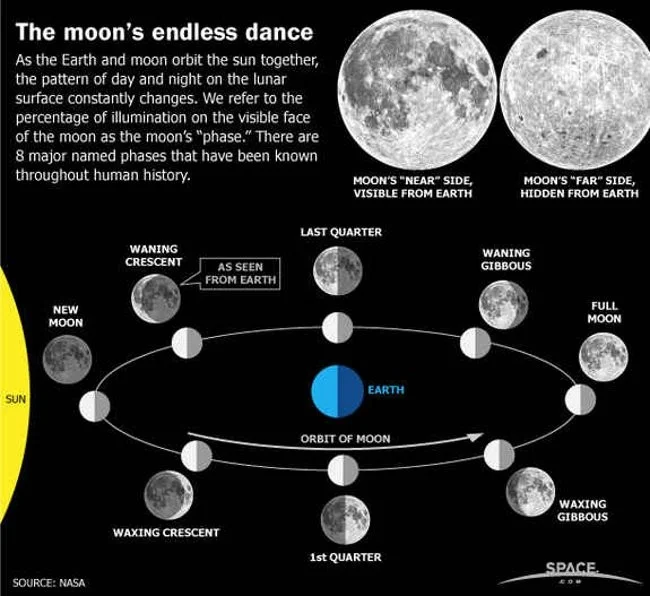 Phases of the moon and the difference between the waxing crescent and the waning or new moon phase. Photo credit: Karl Tate, SPACE.com
Each Full Moon has a precise time of occurrence - which may or may not correspond to the actual time of the moon in your area. Therefore, the Full Moon may be a few hours earlier or later than the actual time. Despite all the technical tools, a normal telescope will not be able to observe this special phenomenon. In fact, the moon will look almost the same two nights in a row after a Full Moon .