Enable XMP to optimize RAM speed

If you're building your own PC and have decided to invest in some fast RAM , how do you make sure it performs at its advertised speed? You may not know this, but in reality, RAM will always run at a slower speed than it was designed for, unless you manually adjust its speed or enable Intel XMP to optimize its speed.

Note that this option is not available on every motherboard BIOS , and not every stick of RAM has an XMP profile. Some RAM models are designed to run at standard speeds only. However, if you're building your own gaming rig and buying a RAM system that's advertised as being extremely fast, you should definitely buy something that supports the XMP option.

Why do we need XMP?

Before enabling XMP, it's important to understand how your CPU connects to RAM and why XMP is necessary in the first place.

You see, the CPU in your system is connected to the RAM through the motherboard using sockets. It is through these sockets that data reaches the CPU. Therefore, the motherboard, CPU, and RAM must work together to get data from the RAM to the CPU.

To keep everything running properly, your computer's motherboard uses a small chip that stores the BIOS (Basic Input/Output System) . This chip is activated when you turn on your computer. After power is applied, the BIOS performs a power-on self-test (POST). During this test, the motherboard checks the status and initializes the various input/output devices connected to the CPU. During this test, the motherboard decides what frequency the RAM should run at.

Enable XMP to optimize RAM speed
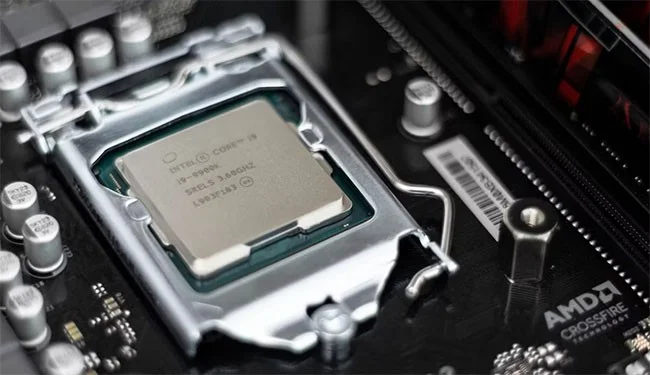
CPU on motherboard

To do this, the motherboard communicates with the Serial Presence Detect (SPD), a chip that stores information such as the RAM's frequency, voltage, and timings. The data stored on this SPD is standardized for different RAM technologies such as DDR2, DDR3, and DDR4 by the Joint-Electron-Device-Engineering-Council (JEDEC).

Because of this standardization, DDR4 RAM can run at frequencies ranging from 800 to 1600 MHz with data rates up to 3200 megatransfers per second (MT/s). However, a high-performance RAM stick can reach 5333 MT/s.

This begs the question, how does RAM surpass the JEDEC specification and run at faster frequencies? This is where XMP comes into play.

What is XMP enabled for?

RAM runs at standard speeds set by JEDEC, but you can overclock your RAM manually. XMP uses some RAM to save a speed and timing profile that the RAM can safely run at. Enabling XMP configures the memory to run at the speed and timings it is rated for.

How to enable XMP on memory

Some motherboards do not allow XMP and will not have an option to enable it or will be grayed out when you try to use the feature. In that case, there is nothing you can do, other than upgrading your motherboard to use XMP.

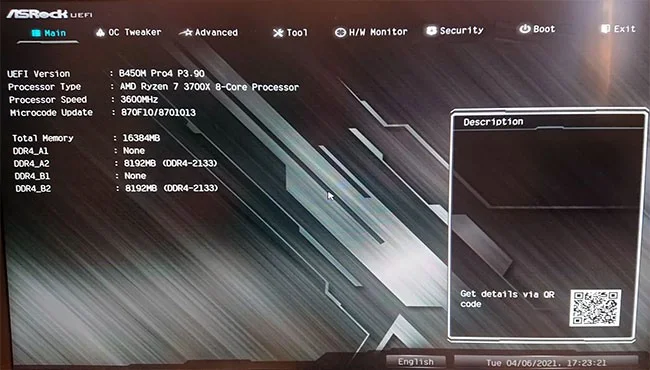
1. Restart your PC or turn it on and access the UEFI/BIOS using the specific key on your motherboard. Typical access keys include Delete, F1, F2, F10, and F12 (yours may be different). Check your motherboard manual or the manufacturer's website for details.

Enable XMP to optimize RAM speed
Access UEFI/BIOS

2. Look for the XMP profile toggle. If you see it on your UEFI/BIOS home screen, toggle it to On , then skip to step 6. If not, skip to step 3.

3. If necessary, enable Advanced Mode in your UEFI/BIOS. This is usually done by pressing the F7 key , but again, this button will depend on your motherboard. Typically, that information is located in the bottom right corner.

4. Navigate to the overclocking section in the BIOS. This section may be called AI Tuner, AITweaker, Performance, Extreme Tweaker, Overclock Settings , or something similar.

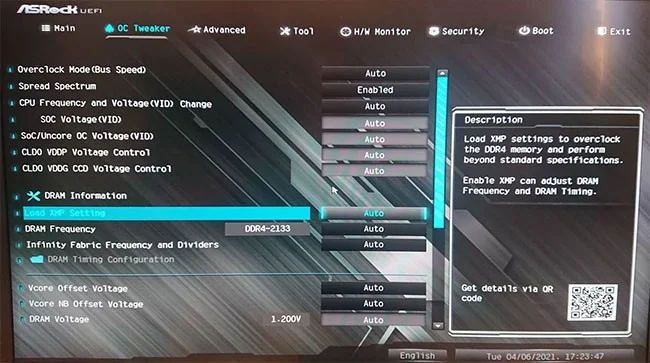
5. Scroll through the list of options until you find the XMP profile toggle. Turn it to On by pressing the Enter key on it or clicking on it and selecting On from the drop-down menu. Some motherboards, like the one below, require you to Load XMP Profile .

Enable XMP to optimize RAM speed
Enable XMP profile

6. Save your BIOS settings and exit. You can do this by selecting the Exit button on your keyboard or mouse and choosing to save your settings. Alternatively, use the traditional F10 key . When prompted, confirm your choice.

How do I know if XMP is enabled?

You can double-check that your XMP profile is enabled by going back into the UEFI/BIOS and making sure the toggle is set to On . Also, check the memory speed in the UEFI/BIOS - it may be on the main screen or overclocking menu - or in the post-boot screen.

You can also use Windows software like CPUZ to confirm your memory speed. If it matches the rated speed given on the memory packaging and label, then your XMP profile is enabled.

If not, rerun the steps to make sure you enabled it correctly. If you are sure you have followed the steps correctly and still are not seeing the expected speeds, you should confirm that your motherboard or processor allows memory overclocking.
See also:

Laisser un commentaire

Healthy snacks that help you lose weight

Healthy snacks that help you lose weight

Craving for snacks but afraid of gaining weight? Dont worry, lets explore together many types of weight loss snacks that are high in fiber, low in calories without making you try to starve yourself.

Résolution des problèmes liés aux paramètres de proxy de Microsoft Teams

Résolution des problèmes liés aux paramètres de proxy de Microsoft Teams

Vous rencontrez des problèmes avec le proxy dans Microsoft Teams ? Découvrez des solutions éprouvées pour résoudre ces erreurs. Videz le cache, ajustez les paramètres du proxy et retrouvez des appels fluides en quelques minutes grâce à notre guide expert.

Pourquoi mon enregistrement Microsoft Teams a-t-il échoué ? Raisons courantes

Pourquoi mon enregistrement Microsoft Teams a-t-il échoué ? Raisons courantes

Vous êtes frustré(e) car votre enregistrement Microsoft Teams a échoué ? Découvrez les principales causes, telles que les problèmes d’autorisation, les limites de stockage et les dysfonctionnements du réseau, ainsi que des solutions étape par étape pour éviter les échecs futurs et enregistrer parfaitement à chaque fois.

Pourquoi ne puis-je pas voir les salles de sous-groupes dans ma réunion Teams ?

Pourquoi ne puis-je pas voir les salles de sous-groupes dans ma réunion Teams ?

Vous êtes frustré(e) car les salles de sous-groupes sont introuvables dans vos réunions Teams ? Découvrez les principales raisons de leur absence et suivez nos solutions pas à pas pour les activer en quelques minutes. Idéal pour les organisateurs comme pour les participants !

Résolution des problèmes liés au trousseau derreurs de Microsoft Teams sur Mac

Résolution des problèmes liés au trousseau derreurs de Microsoft Teams sur Mac

Vous rencontrez des problèmes avec le Trousseau d'accès Microsoft Teams sur Mac ? Découvrez des solutions de dépannage éprouvées et détaillées pour macOS afin de retrouver une collaboration fluide. Des solutions rapides à l'intérieur !

Où se trouvent les clés de registre de Microsoft Teams sous Windows 11 ?

Où se trouvent les clés de registre de Microsoft Teams sous Windows 11 ?

Découvrez l'emplacement précis des clés de registre Microsoft Teams sous Windows 11. Ce guide pas à pas vous explique comment les trouver, y accéder et les modifier en toute sécurité pour optimiser les performances et résoudre les problèmes. Indispensable pour les professionnels de l'informatique et les utilisateurs de Teams.

Comment résoudre lerreur 1200 de Microsoft Teams sur téléphone (iOS/Android)

Comment résoudre lerreur 1200 de Microsoft Teams sur téléphone (iOS/Android)

Vous en avez assez de l'erreur 1200 de Microsoft Teams qui interrompt vos appels téléphoniques ? Découvrez des solutions rapides et simples pour iOS et Android afin de reprendre rapidement une collaboration fluide, sans aucune compétence technique requise !

Où se trouve Microsoft Teams dans Outlook ? Localisation de l’icône manquante

Où se trouve Microsoft Teams dans Outlook ? Localisation de l’icône manquante

Vous êtes frustré(e) par la disparition de l'icône Microsoft Teams dans Outlook ? Découvrez où la trouver, pourquoi elle disparaît et comment la faire réapparaître pour des réunions sans souci. Mise à jour pour les dernières versions !

Comment résoudre lerreur « Longlet Wiki de Microsoft Teams ne se charge pas »

Comment résoudre lerreur « Longlet Wiki de Microsoft Teams ne se charge pas »

Vous rencontrez des difficultés avec le chargement des onglets Wiki dans Microsoft Teams ? Découvrez des solutions éprouvées, étape par étape, pour résoudre rapidement le problème, restaurer vos onglets Wiki et optimiser la productivité de votre équipe en toute simplicité.

Comment résoudre lerreur matérielle de Microsoft Teams (correction du registre 2026)

Comment résoudre lerreur matérielle de Microsoft Teams (correction du registre 2026)

Vous en avez assez des plantages de Microsoft Teams avec erreur critique ? Découvrez la solution éprouvée de 2026 modifications du registre qui résout le problème en quelques minutes. Guide pas à pas, captures d'écran et astuces pour une solution définitive. Compatible avec les dernières versions !