Accueil
» Wiki
»
AMDs 9000-Series CPUs Are Here, But Why Not Buy Now?
AMDs 9000-Series CPUs Are Here, But Why Not Buy Now?
AMD's anticipated Zen 5-powered Ryzen 9000-Series launch hasn't been smooth sailing. Inventory recalls, performance discrepancies, and testing issues have all created problems for AMD's new CPUs.
So while AMD's 9000-Series CPU specs look great on paper, there are a few reasons why you should wait for the more powerful Ryzen 9000X3D chips.
1. Too many bugs with the original Ryzen 9000
First, there are too many general performance issues with AMD's new CPUs.
AMD’s first batch of Ryzen 9000 processors was delayed after last-minute quality issues were discovered during packaging testing. These issues were so serious that AMD decided to recall all units that had already been shipped to retailers and OEMs. While a prudent move, the move highlights significant concerns about the reliability of early production products.
Additionally, AMD’s performance figures don’t match up with independent reviewers’ findings. AMD’s initial internal testing showed an average 9% performance increase in 1080p gaming compared to previous-generation Ryzen 7000 Series CPUs. However, many independent reviewers claim performance gains of only 2-5%.
Further testing revealed that AMD used a hidden Windows admin account during internal testing. Windows system account permissions limit the performance of both Zen4 and Zen5 CPUs, causing benchmark results to drop. Independent reviewers confirmed this after achieving 2-4% performance gains when using a Windows admin account.
So, logging in as an admin should solve the problem, right? Yes, but the admin account is not the same as logging in as a Windows admin. It is a hidden administrator account that requires Command Prompt (CMD) to activate. While anyone can access this account, it has two main disadvantages.
First, this is a new account, so you will have to reinstall all your software and set up all your files and settings, which is a big hassle. Second, logging into this admin account greatly increases your system's security vulnerability because it grants elevated privileges that malware can exploit.
A 2-4% performance increase is simply not worth the hassle of installing apps, setting up accounts, and jeopardizing your security.
2. Ryzen 9000X3D has more cache
Issues aside, the upcoming X3D versions will provide a more compelling reason to consider upgrading: AMD's 3D V-Cache technology. AMD's X3D technology has provided a significant 10-15% performance boost to its Ryzen 7000 and 5000 CPUs.
CPU cache is a key component in a processor that helps applications run smoothly. With the upcoming Ryzen 9000X3D CPU adding 64MB of L3 cache, expect lower latency and improved performance in cache-sensitive applications like gaming.
Furthermore, with AMD claiming a 16% increase in IPC (instructions per clock cycle) on its new Zen5 architecture, the Ryzen 9000X3D chip should deliver even higher gaming performance than the previous-generation Ryzen 7000X3D.
3. Full overclocking potential
One of the most exciting prospects for the X3D variants of the Ryzen 9000 series is the potential for full overclocking support. Previous X3D models were limited in this regard due to the complexity of thermal management with the additional 3D V-Cache.
Anandtech reports that the regular 9000 Series CPUs use a mix of TSMC's 4nm and 3nm manufacturing processes. As for the 3D V-Cache chiplets, Guru3D reports that the third-generation 3D V-Cache could use a 5nm fabrication process, which would offer significant improvements over the second-generation 3D V-Cache, which uses a 7nm process node (according to Tom's Hardware).
The smaller manufacturing process on 3D V-Cache should help with overclocking due to lower temperatures and other benefits of using a smaller process node. And, based on the previous two generations of 3D V-Cache, the smaller process nodes seem to allow for better overclocking support.
The first generation of AMD's 3D V-Cache on Zen3 allowed for memory overclocking. Then Zen4 came along and Precision Boost Overdrive (PBO) was enabled. With lower temperatures, the third generation was set to support overclocking.
This could make the Ryzen 9000X3D a great choice if you want to squeeze every ounce of performance out of your system, and it would be worth the wait if it turns out to be true. However, it's important to note that the potential for overclocking support is entirely based on the trend and speculation that the upcoming 3D V-Cache will use the 5nm process node.
5nm 3D V-Cache will most likely result in higher CPU clock speeds. So not only will the Ryzen 9000X3D CPU have more cache, it will also likely have higher clock speeds than the existing base Ryzen 9000 CPU. For full overclocking support, AMD will likely need to do more than just fabricate 3D V-Cache on the 5nm process.
However, a PC Gamer interview with Donny Woligroski (AMD's senior director of technical marketing) highlighted that AMD is doing more than just adding V-Cache to the chip.
So, while vague, full overclocking support is definitely possible.
4. Zen 5 X3D is coming soon
Finally, the upcoming release of the Zen 5 X3D processors is another reason to hold off on buying the current Ryzen 9000 series. Rumors suggest that these CPUs could be released as early as the end of this year or possibly early next year, and they are expected to offer not only improved performance, but also improved efficiency and better pricing compared to the original Zen 5 releases.
How much does AMD's new Ryzen 9000 CPU line cost?
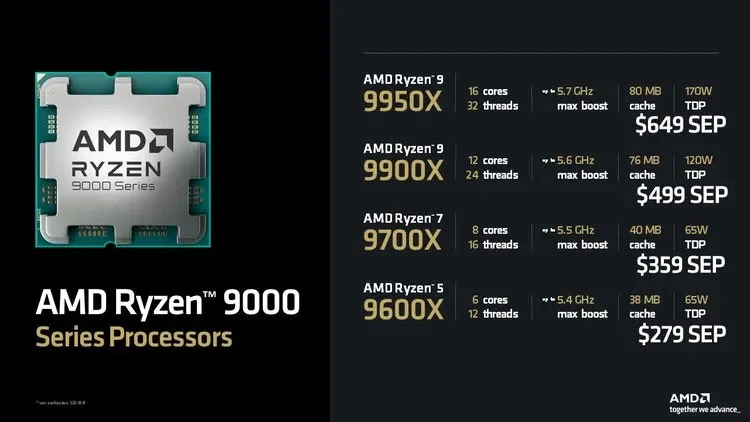
AMD has finally revealed launch pricing for its new Ryzen 9000 desktop CPU lineup, and it’s priced slightly lower than the Ryzen 7000 launch price. The top-of-the-line 16-core Ryzen 9 9950X will cost $649, $50 less than the $699 Ryzen 9 7950X that launched nearly two years ago. The rest of the lineup is priced between $20 and $50 less than comparable Ryzen 7000 CPUs.
After delaying the launch of the Ryzen 9000 CPUs "out of an abundance of caution," the Ryzen 7 9700X ($359) and Ryzen 5 9600X ($279) both launched on August 8, followed by the Ryzen 9 9950X ($649) and Ryzen 9 9900X ($499) on August 15.